
Tight Doesn’t Always Mean Strong
By Dr. Cassie Tayon, DC · October 13, 2026 · 5 min read
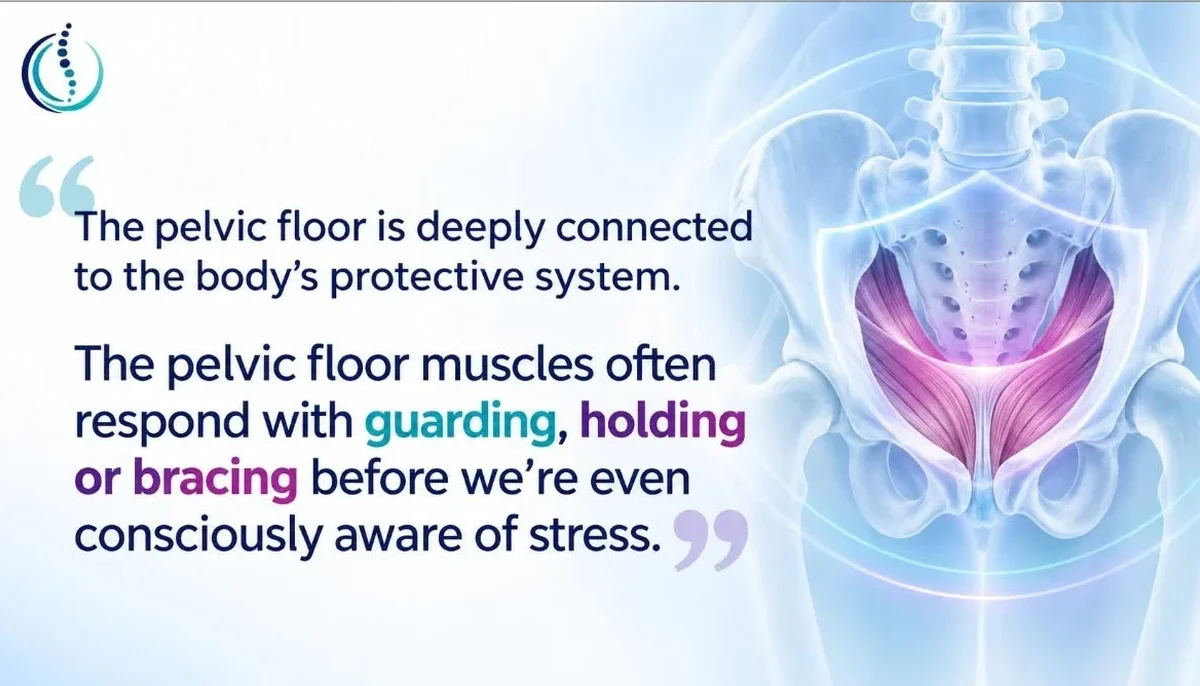
A few weeks ago I wrote about the pelvic floor as the bottom of the core, part of a much bigger whole-body system. After a weekend of training on exactly that, one idea has stayed with me more than any other, and it applies well beyond the pelvis.
Sometimes the body is not weak or tight. Sometimes it is protecting.
Tightness as a strategy
We tend to read tightness as a mechanical problem: a muscle that is too short and needs stretching, or too weak and needs strengthening. Often that is true. But there is a third possibility that gets missed, and it changes what helps.
Stress, injury, pain and past trauma can change the way we breathe, brace, move, digest and hold tension. The body learns that certain areas do not feel safe, and it guards them. That guarding feels like tightness. You can stretch it and it loosens for an hour. You can strengthen around it and it holds on harder. Because the tightness was never the problem; it was the body’s answer to a problem.
Most of us notice this in the shoulders, the jaw or the stomach. Those are the places that grip when a hard week lands on us. The low back does it. The abdomen does it, in people who have been bracing their stomach all day for years without realizing. And the pelvic floor does it too, because it is wired into the same protective response as everything else.
Why a gripping system does not work well
A muscle that is always on is not a strong muscle. It is a muscle that has lost its range. Strength needs the ability to contract and then fully let go, and a system that never lets go cannot generate force well, cannot coordinate with its neighbors, and cannot manage pressure the way it is supposed to.
The pelvic floor is a good example. It works with the diaphragm, the core, the spine, fascia and the nervous system, and it is supposed to move with every breath. A pelvic floor that is constantly gripping is not functioning efficiently, however strong it might test. People in this state are often told to do more strengthening, and more strengthening makes a gripping system grip more.
Sometimes the answer is not more strength. Sometimes it is better breathing, better pressure control, better coordination, more movement, and a nervous system that has been given reason to stand down.
Sciatica, SI joint, hip and pelvic pain that will not resolve
This is where I see it most. Someone has had sciatica, SI joint pain, hip pain or pelvic pain for months or years. They have been treated, often well, by more than one provider. It improves and comes back. They start to believe this is simply how their body is now.
Persistent pain deserves a fresh assessment, and for some of these people the overlooked piece is pelvic floor coordination. The pelvic floor muscles work with breathing, the abdominal muscles and the spinal muscles to support the core. When they stay tense and guarded, in protection mode, they can contribute to pain and to difficulty moving comfortably, and they can keep pulling the pelvis and low back back into the same pattern every time it is corrected.
Learning to relax and coordinate these muscles, rather than strengthen them further, may help reduce the guarding and improve how you move. It is not the answer for everyone. It is an answer that is rarely considered, and it costs nothing to ask the question.
What the body might need instead
When I look at a protective pattern now, I am trying to work out which of a few things the body is asking for. Sometimes it needs more support, because an area really is unstable and the guarding is doing a job. Sometimes it needs more mobility, because the restriction is real and the tissue has to be able to move before anything else can change. Sometimes it needs better coordination, because the parts are all capable and simply not working together. And sometimes it needs help learning that it does not have to keep guarding, which is a nervous system job more than a muscle job.
Those four answers call for very different care. That is why two people with the same complaint may leave my office with very different plans, and why I will not tell you what your body needs before I have looked at it.
What this looks like in our office
None of this replaces what we already do. Gentle, specific adjusting, the tools we use to support the nervous system, and the time we spend understanding your history all stay. What we are adding, where it fits, is a better understanding of how the diaphragm, core, pelvis, breathing and nervous system work together, and a willingness to look at the pelvic floor as part of a pattern rather than a separate problem.
The goal is not to turn every problem into a pelvic floor problem. The goal is to understand why the body is creating the pattern in the first place, and then to help it work together instead of simply harder.
If you have persistent sciatica, SI, hip or pelvic pain, or a tight spot anywhere that you have been managing for years, you are welcome to talk privately with Dr. Winters or me about whether a fresh look, including a pelvic floor evaluation, could be your next step.
~ Dr. Cassie
This article is general education, not medical advice for your situation.