Your Pelvic Floor Is the Bottom of Your Core
By Dr. Cassie Tayon, DC · October 13, 2026 · 6 min read

When most people hear “pelvic floor,” they think of one of a few things: women’s health, bladder leakage, pregnancy, or sexual function. Those are real and important. But they are a small corner of what the pelvic floor does, and limiting it to those topics is one reason so many people, men included, never think about it at all.
Here is a simpler way to picture it. Your pelvic floor is the bottom of your core. It is a group of muscles and connective tissue that forms the floor of your pelvis, and it works together with your diaphragm, your abdominal wall, your spine, your hips and your nervous system every time you breathe, walk, bend, lift, brace or move. You use it constantly. You just never feel yourself doing it.
A system, not a muscle
One thing I have been enjoying about recent training is seeing the core as a whole system rather than a group of separate muscles. Your diaphragm sits at the top. Your abdominal wall wraps the front and sides. Your spine and the muscles along it hold the back. Your pelvic floor closes the bottom. Fascia, the connective tissue that surrounds and links all of these, ties the whole thing together.
These parts coordinate to do a few jobs at once: help you breathe, keep you stable, and manage pressure inside your body as you move. When you take a breath in, your diaphragm moves down and your pelvic floor gives a little to make room. When you breathe out, both return. When you lift something heavy, they work together to brace. It is a constant, quiet conversation, and it happens thousands of times a day.
When that coordination is off, other areas start compensating. The low back takes on more than its share. The hips grip. Breathing gets shallow and moves up into the chest and neck. The body finds a way to get the job done, and the way it finds is not always a comfortable one.
What that can look like in real life
This is where it becomes practical. When the pelvic floor is not coordinating well with the rest of the core, the body may compensate with patterns of tension or guarding that show up in places you would never connect to the pelvis. Some of the patterns I see most often:
- Low back or SI joint discomfort that keeps coming back no matter how much it is treated
- Hip tension that stretching never seems to resolve
- Abdominal bracing, where the stomach stays tight all day without you deciding to tighten it
- Difficulty relaxing, even when there is nothing to be tense about
- A change in breathing, usually toward shallow breaths that live in the upper chest
- The more familiar pelvic floor symptoms, in both men and women
Any one of these can have other causes. But when several show up together, and especially when they keep returning after treatment, the pelvic floor is worth looking at as part of the picture.
Why fascia matters here
Fascia is the connective tissue that surrounds and links your muscles and other structures. In the pelvis it helps support organs, distribute forces and let tissues move together instead of against each other. Fascia also contains sensory nerve endings, so it is part of how you sense movement and part of how you sense pain.
There is an anatomy model called the deep front line that maps a continuous connection through the deep muscles and fascia of the body, from the feet and inner legs, up through the pelvis, toward the diaphragm and the neck. I find it a useful way to think about why pelvic floor function does not stay in the pelvis. A restriction low in that line can change how things feel higher up, and discomfort is sometimes felt a long way from where it starts.
When pelvic muscles and the tissue around them become painful or stay guarded, bending, walking and hip movement can feel uncomfortable or restricted. That is not weakness, and it is usually not something to push through. It is a system that has lost some of its coordination and needs help getting it back.
Where the nervous system comes in
If you have read anything else on this page, you know that I spend most of my time looking at the nervous system and how the body responds to stress, protection and safety. Polyvagal theory gives us a way to think about those patterns: how breathing, muscle guarding, digestion, heart rate and the way we physically hold ourselves all change when the nervous system feels under threat.
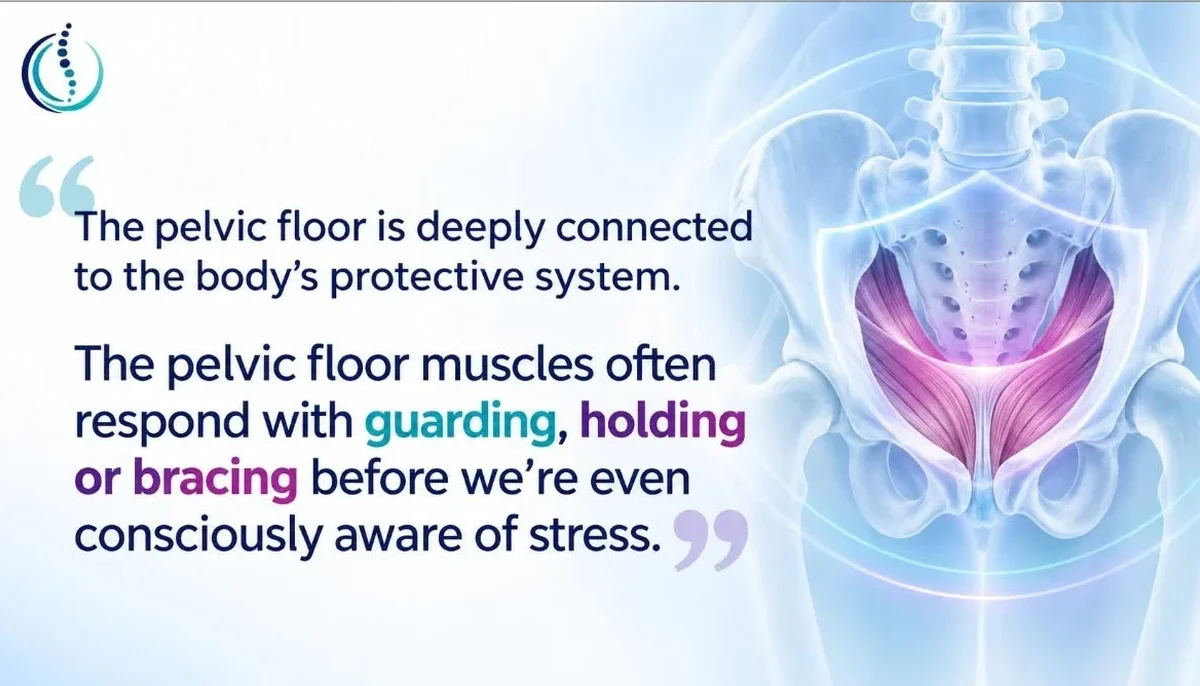
The pelvic floor is part of that response. Most of us can feel stress in our shoulders, our jaw or our stomach. The pelvic floor participates in the same protective reflex; it just does so out of sight. That is why pelvic floor health involves more than strengthening. These tissues need to contract, relax and move comfortably in coordination with breathing and everyday activity, and a nervous system stuck in protection mode can make that hard.
This is not about turning every problem into a pelvic floor problem. It is about continuing to look at the body as one connected system instead of a collection of separate parts, which is the approach we have always taken here.
This matters for men too
I want to say this plainly because it gets skipped: the pelvic floor matters for men and women. Men have one. It does the same structural work. It participates in the same guarding patterns. And men are far less likely to ever hear the words “pelvic floor” from a provider, which means a piece of the picture gets left out of their care.
If you are a man with persistent low back, hip or SI pain that has been treated more than once and keeps returning, this is one more thing worth asking about.
If this feels personal to bring up
We understand that pelvic floor symptoms can feel personal or uncomfortable to talk about. If you would prefer to talk privately, let us know when you call or come in. You are welcome to speak with either Dr. Winters or me, whichever you are more comfortable with. Our goal is simply that you feel safe asking the question and can get the care and support you need.
We are beginning to add this whole-system view of the core into the nervous-system care we already provide, where it is appropriate for the person in front of us. If you have been living with one of the patterns above, I would be glad to look at the bigger picture with you.
~ Dr. Cassie
This article is general education, not medical advice for your situation.